You refreshed the page three times, added the item to your cart, and then hesitated for just a moment. By the time you clicked "buy," the price had jumped $40 and the deal was gone. If that sounds familiar, you're not alone. Trending deals on electronics and gadgets move fast, and the window to grab them can close in hours. This guide walks you through every stage of the process, from setting up the right tools to verifying that a deal is actually worth your money, so you stop missing out and start buying smarter.
Table of Contents
- Essential tools and platforms for spotting trending deals
- Step-by-step process to identify trending deals
- Safety checks: Avoiding counterfeits and too-good-to-be-true deals
- Validating trending deals for reliability and value
- Our perspective: Why finding trending deals is about smart strategy, not luck
- Head straight to the best deals with Deal Finder Pro
- Frequently asked questions
Key Takeaways
| Point | Details |
|---|---|
| Monitor top lists | Check Best Sellers, Movers & Shakers, and Wish Lists for trending gadgets. |
| Verify every deal | Always review seller reputation, warranties, and product specs before buying. |
| Beware extreme discounts | Big discounts can signal counterfeits or outdated products—cross-check reviews first. |
| Leverage tech tools | Use deal monitoring tools and alert services to save time and catch trends early. |
| Smart strategy wins | Follow a systematic process instead of relying on luck or hype for the best value. |
Essential tools and platforms for spotting trending deals
Before you can catch a trending deal, you need to know where to look. The good news is that the major e-commerce platforms have built-in signals that tell you exactly what's gaining traction right now. The challenge is learning how to read those signals correctly.
Amazon offers three powerful lists that serious deal hunters use daily. Monitor Amazon's Best Sellers, Movers & Shakers, and Most Wished For lists to spot trending electronics and gadgets gaining rapid popularity. Best Sellers shows what's already hot. Movers & Shakers shows what's becoming hot, updated hourly. Most Wished For reveals what shoppers want but haven't bought yet, which often predicts the next wave of demand and price drops.
eBay has its own trending section under "Explore," and its "Sold Listings" filter is underrated. When you filter by sold items in a category like wireless earbuds or smartwatches, you can see real transaction prices and how quickly items are moving. That's real market data, not just wishful listing prices.
Walmart and Best Buy both run flash sale sections and clearance categories that update frequently. Best Buy's Deal of the Day is time-limited and often features genuine discounts on name-brand electronics. Walmart's Rollback section can surface unexpected savings on laptops, tablets, and smart home devices.
Here's a quick comparison of how each platform handles deal discovery:
| Platform | Best feature for deal discovery | Update frequency | Best for |
|---|---|---|---|
| Amazon | Movers & Shakers list | Hourly | Spotting emerging trends fast |
| eBay | Sold Listings filter | Real-time | Verifying actual market prices |
| Walmart | Rollback section | Daily | Budget electronics and tablets |
| Best Buy | Deal of the Day | Daily | Brand-name tech at real discounts |
| AliExpress | Flash Deals section | Every few hours | Budget gadgets and accessories |
Beyond the platforms themselves, third-party tools add another layer of intelligence. Browser extensions like CamelCamelCamel track Amazon price history and show you whether today's "sale" is actually a discount or just a reset from an inflated price. Honey and Capital One Shopping automatically apply coupon codes and track price changes across multiple sites. For power users, methods for spotting trending deals through aggregated platforms save hours of manual searching.
Key tools worth bookmarking:
- CamelCamelCamel: Amazon price history tracker
- Honey: Automatic coupon application and price alerts
- Google Shopping: Cross-platform price comparison
- Slickdeals: Community-curated deal alerts with voting
- Camelizer: Browser extension for instant price history on Amazon listings
The combination of platform-native lists and third-party tracking tools gives you a two-layer system. One layer shows you what's trending right now. The other shows you whether the price is actually a deal or just clever marketing.
Step-by-step process to identify trending deals
Now that you've assembled your toolkit, here's how to put it into action. This process works whether you're hunting for a specific product or browsing for the best opportunity across categories.
Step 1: Start with Amazon's Movers & Shakers list. Filter by Electronics or a subcategory like headphones or smart home devices. Look for items that have jumped 500 spots or more in the rankings within the past 24 hours. That kind of movement signals real buying activity, not just a temporary spike from a single viral post.

Step 2: Cross-reference on eBay. Take the product name you found and search it on eBay with the "Sold Listings" filter active. If you see dozens of recent sales at prices close to or below the Amazon listing, the demand is real. If eBay sold listings are sparse, the trend might be Amazon-specific or artificially boosted.
Step 3: Check price history. Before you get excited, run the product through CamelCamelCamel. A product listed at "$89, down from $129" sounds great until you see it was $79 three months ago. Price history kills the illusion of a deal instantly.
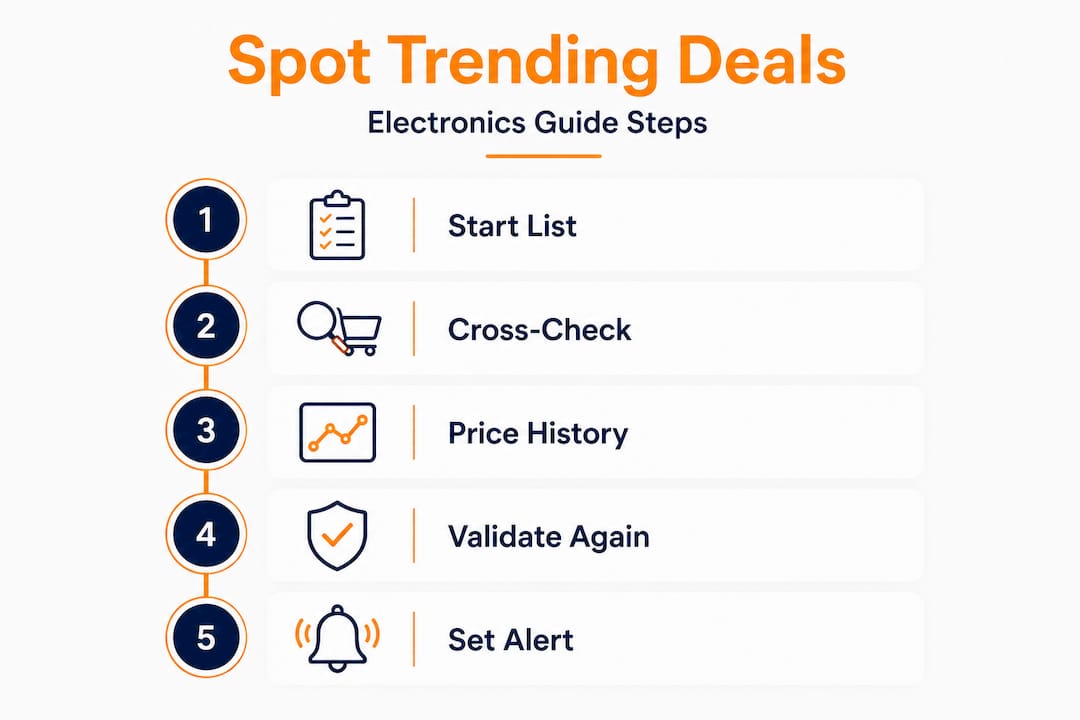
Step 4: Validate on a third platform. Check Walmart, Best Buy, or Google Shopping for the same item. If the price you found is genuinely the lowest across platforms, you've confirmed a real deal. If another retailer has it cheaper, you've just found an even better one.
Step 5: Set a price alert. If the item isn't at your target price yet, set an alert through CamelCamelCamel or Honey. You define the threshold, and you get an email the moment the price drops. This removes the need to refresh pages obsessively.
Step 6: Act within the window. Trending deals, especially on Amazon, often sell out or revert to full price within 24 to 48 hours. Once you've verified the deal is legitimate, don't wait more than a day to decide.
Pro Tip: Set up a dedicated email folder for price drop alerts. When you get a notification, you can scan it quickly and act without digging through your inbox. Speed matters when a deal is trending.
The electronics deal spotting guide at Deal Finder Pro aggregates signals from multiple platforms simultaneously, which compresses this six-step process into a single search. But understanding the manual process makes you a sharper shopper regardless of which tools you use.
A real-world example: Suppose you spot a pair of noise-canceling headphones climbing fast on Movers & Shakers. You check eBay sold listings and see 40 sales in the past week at similar prices. CamelCamelCamel shows the price is at a 14-month low. Google Shopping confirms no other retailer is cheaper. That's a confirmed trending deal with validated pricing. You buy with confidence.
Safety checks: Avoiding counterfeits and too-good-to-be-true deals
You've spotted a deal. Now comes the part most shoppers skip: verification. Skipping this step is how people end up with counterfeit earbuds that break in two weeks or "refurbished" laptops that were never properly tested.
Verify seller reputation, warranty, specs compatibility, and total cost including shipping and tax before buying deep discounts on gadgets to avoid counterfeits or refurbished pitfalls. That's not just cautious advice. It's the difference between a great deal and an expensive mistake.
Here's how to evaluate a seller before you buy:
- Check the seller's feedback score on eBay (look for 98% or higher positive ratings)
- On Amazon, look for the "Sold by" information. Third-party sellers with fewer than 100 reviews carry more risk
- Read the one-star reviews first. They reveal patterns of counterfeit complaints, poor packaging, or missing accessories
- Verify the product listing includes a serial number, model number, and manufacturer warranty
- Calculate the total cost including shipping and tax. A $59 gadget with $18 shipping isn't the deal it appeared to be
Here's a comparison to help you distinguish genuine deals from risky ones:
| Factor | Genuine deal | Risky deal |
|---|---|---|
| Seller rating | 98%+ positive, many reviews | New seller, few or no reviews |
| Discount level | 15% to 40% off | 70%+ off with no clear reason |
| Warranty included | Manufacturer warranty stated | "As-is" or no warranty mentioned |
| Product images | Professional, brand-consistent | Blurry, inconsistent, or stock photos |
| Shipping cost | Reasonable or free | Unusually high or suspiciously low |
| Return policy | Clear, 30-day return window | Vague or no return policy |
"Verify seller reputation, warranty, specs compatibility, and total cost including shipping and tax before buying deep discounts on gadgets to avoid counterfeits or refurbished pitfalls." This principle applies across every platform, from Amazon to AliExpress.
Pro Tip: On AliExpress especially, always filter by sellers with "Top Brand" or "Choice" badges and look for buyer photos in the reviews section. Real photos from real buyers are the strongest signal that a product is what it claims to be.
The deal authenticity verification tools available through Deal Finder Pro help flag sellers with low ratings or suspicious pricing patterns, which adds a layer of protection before you even click through to a listing.
Validating trending deals for reliability and value
Spotting a deal and verifying the seller are steps one and two. Step three is confirming the deal is genuinely trending and not just a flash in the pan promoted by a single influencer or a paid placement.
1. Check multiple trend signals, not just one. A product appearing on Amazon's Movers & Shakers and trending on Reddit's r/deals and showing up in Google Trends is a legitimately trending item. A product that only appears in one place might be the result of a single promotion.
2. Look at review velocity. A product with 200 reviews added in the past 30 days is moving fast. A product with 2,000 total reviews but only 10 in the past month is stagnating, regardless of how it looks on a Best Sellers list.
3. Cross-check the product's generation. Sometimes retailers discount last-generation products heavily to clear inventory. A 60% discount on a smartphone sounds incredible until you realize it's two generations old and the manufacturer has stopped security updates. Always check the model year and compare it to the current lineup.
4. Validate post-purchase if something feels off. If your item arrives and doesn't match the listing description, act immediately. Most platforms have buyer protection windows of 30 to 90 days. Document everything with photos and contact the seller first, then escalate to platform support if needed.
Extreme discounts like 75% off earbuds often indicate counterfeits or heavily degraded last-gen products. Cross-checking reviews and seller ratings before you buy is the single most effective way to protect yourself.
A useful rule of thumb: if a deal seems so good that you feel a rush of urgency without thinking clearly, pause. That feeling is exactly what bad actors count on. Give yourself five minutes to run through the validation checklist before you complete the purchase.
Our perspective: Why finding trending deals is about smart strategy, not luck
Here's something most deal-hunting content won't tell you: chasing trending deals without a system is just gambling with better odds. You might win occasionally, but you'll lose more often than you realize, and the losses are harder to track because they come in the form of time wasted, mediocre products bought at "good enough" prices, and counterfeit items that seemed fine until they weren't.
The real advantage in deal hunting isn't speed. It's discipline. The shoppers who consistently get the best value aren't the ones refreshing pages at midnight. They're the ones who set up alerts, understand price history, and know exactly what a fair price looks like before a sale starts. When a deal drops, they recognize it instantly because they've done the homework in advance.
There's also a common misconception worth addressing: trending does not mean best value. A product can trend because of a viral video, a celebrity endorsement, or a coordinated marketing push. None of those things make it a better product or a better deal. The discipline to ask "is this actually worth it at this price?" separates smart shoppers from reactive ones.
Smart deal strategies are built on data, not hype. Use the tools available to you, understand the signals, and trust the process over the impulse. That's how you consistently win at deal hunting, not by being lucky, but by being prepared.
Head straight to the best deals with Deal Finder Pro
You now have a complete system for spotting, verifying, and validating trending deals on electronics and gadgets. But running this process manually across five platforms takes time, and time is exactly what you don't have when a deal is moving fast.
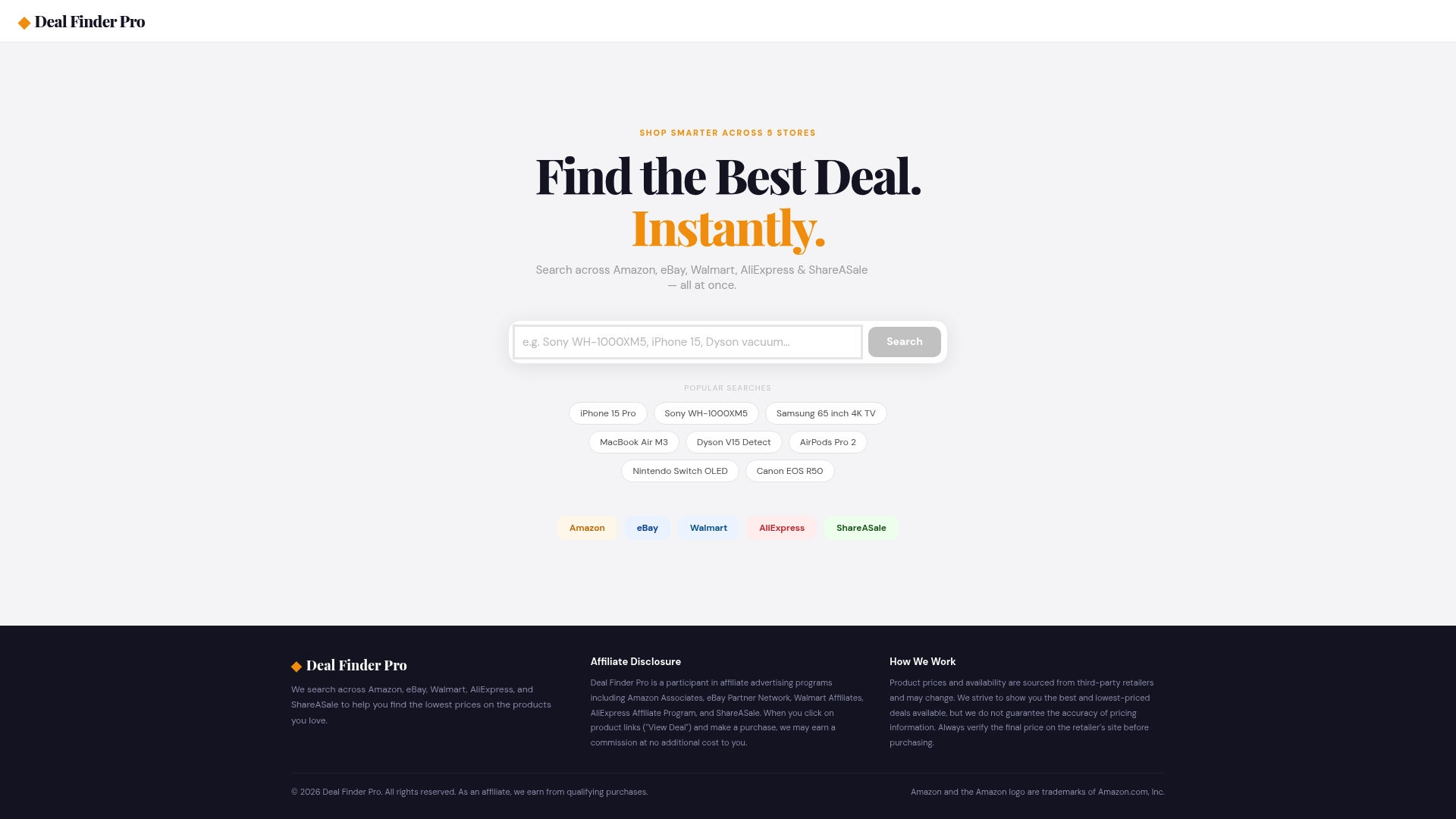
Deal Finder Pro was built to solve that exact problem. By aggregating search results from Amazon, eBay, Walmart, AliExpress, and ShareASale simultaneously, it compresses your research into a single search. You get real-time price comparisons, trending product lists, and the ability to find deals instantly without jumping between tabs. Whether you're hunting for headphones, laptops, or smart home gadgets, Deal Finder Pro surfaces the most competitive prices across all major platforms in seconds. Stop chasing deals manually and start shopping with the advantage of aggregated intelligence behind every search.
Frequently asked questions
What signs indicate a tech deal is trending?
Trending tech deals often appear on Best Sellers, Movers & Shakers, or Most Wished For lists on major platforms like Amazon, especially when combined with rising search volume on Google Trends.
How can I avoid counterfeit gadgets when chasing discounts?
Always check seller reputation, warranty details, and product reviews before buying deals with deep discounts. Verify total cost including shipping and tax, and look for manufacturer warranty information in the product listing.
Are extreme discounts (over 70%) on gadgets safe to trust?
Extreme discounts on gadgets may signal counterfeit, heavily degraded, or last-generation products. Always verify with seller ratings and recent product reviews before purchasing.
Can I use Deal Finder Pro to spot trending deals on electronics?
Yes, Deal Finder Pro offers curated lists and real-time alerts for trending deals in electronics and gadgets, aggregating results from Amazon, eBay, Walmart, AliExpress, and ShareASale in one place.