
Nearly nine in ten electronics buyers have noticed recent price increases, and 47% wait for deals before pulling the trigger on a purchase. That single stat flips the old narrative that online shoppers are impulsive spenders. The reality is sharper: today's tech buyer is patient, strategic, and increasingly skilled at squeezing maximum value from every dollar. This article breaks down exactly why that shift happened, what motivates deal-seeking behavior, and how you can apply proven strategies to land better prices on smartphones, laptops, headphones, and every other gadget on your list.
Table of Contents
- The rising price consciousness among online shoppers
- Deal-seeking behaviors and strategies
- Understanding the value equation: Beyond price alone
- Applying deal-hunting strategies: Practical steps for tech shoppers
- What most guides miss about deal seeking
- Find deals faster with Deal Finder Pro
- Frequently asked questions
Key Takeaways
| Point | Details |
|---|---|
| Price sensitivity rising | Most electronics shoppers are more conscious of prices due to inflation and increased living costs. |
| Smart deal strategies | Comparing platforms, timing purchases, and using price trackers help shoppers find better deals on gadgets. |
| Value goes beyond price | Tech-savvy shoppers focus on product specs, reviews, and longevity—not just discounts. |
| Early shopping advantage | Starting holiday deal hunting early increases chances of getting the best offers and promotions. |
The rising price consciousness among online shoppers
The electronics market has changed dramatically over the past few years. Inflation, supply chain disruptions, and shifting trade policies have pushed prices upward across nearly every product category. Shoppers have noticed, and they have responded by changing how they buy.
"Price increases have become the new normal in consumer electronics. Shoppers are no longer surprised. They are simply more strategic." This shift in mindset is one of the most significant behavioral changes in retail history.
The numbers back this up clearly. 62% of global consumers now spend more time searching online for deals and discounts than they did before, cutting back on nonessentials like electronics when prices feel too high. That is not a small group of extreme bargain hunters. That is the majority of the market actively changing its behavior.

Price has also become the dominant decision factor. 46% of global consumers cite price as the single most important purchasing factor when buying tech durables. That means nearly half of all buyers rank price above brand loyalty, features, and even convenience.
Here is what this price consciousness looks like in practice:
- Waiting for seasonal sales like Black Friday, Cyber Monday, and Amazon Prime Day before buying big-ticket items
- Tracking price history using browser extensions and dedicated tools to identify genuine discounts versus inflated "sale" prices
- Brand switching when a lesser-known manufacturer offers comparable specs at a significantly lower price point
- Buying fewer items overall, consolidating purchases to maximize the impact of a single deal
- Delaying purchases by weeks or months until a price drop makes the buy feel justified
These behaviors are not random. They reflect a calculated approach to spending that has become the default mode for millions of online shoppers. Exploring different deal hunting methods has become a standard part of the research process, not an afterthought.
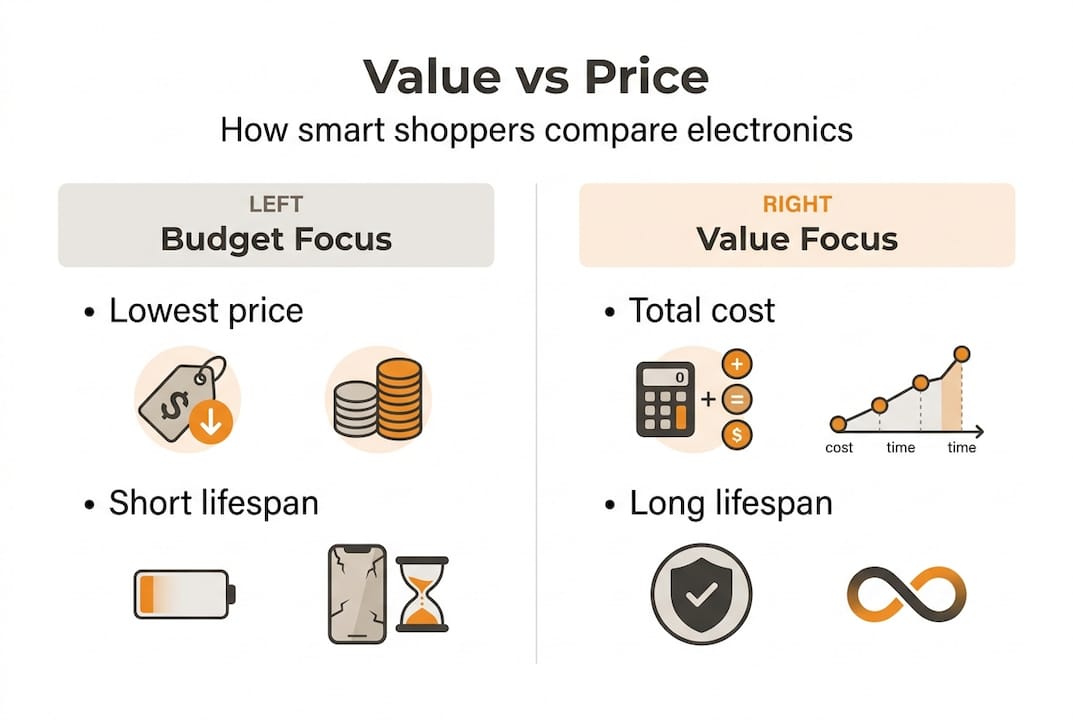
The interesting wrinkle here is that price consciousness does not mean shoppers are always chasing the absolute lowest number. Many are chasing the best value, which is a more nuanced target. A $400 laptop that lasts five years beats a $250 model that fails in eighteen months. Price consciousness, at its best, is really value consciousness wearing a discount badge.
Deal-seeking behaviors and strategies
Understanding why shoppers seek deals is one thing. Understanding how they do it is where the real insight lives. The methods have grown more sophisticated, and the tools available today make it easier than ever to shop with precision.
Subscription services as comparison tools
One of the more interesting trends is how shoppers use retail membership programs not just for shipping perks, but as active deal-finding instruments. Nearly a quarter of consumers subscribe to both Amazon Prime and Walmart+ simultaneously, using both platforms to compare prices, stack discounts, and secure the best available deal on any given product. Paying for two memberships to save money on purchases sounds counterintuitive, but for frequent buyers of electronics and gadgets, the math often works out favorably.
Price tracking tools
Historical price trackers are among the most powerful weapons in a deal seeker's toolkit. Tools like CamelCamelCamel for Amazon track price history over months and years, letting you see whether a "40% off" label reflects a genuine reduction or a price that was artificially inflated before the sale. This kind of transparency has fundamentally changed how informed shoppers evaluate promotions.
Sales cycle timing
Knowing when to buy is just as important as knowing where to buy. Here is a quick breakdown of the major sales cycles for electronics:
| Sales event | Typical timing | Best categories |
|---|---|---|
| Black Friday / Cyber Monday | Late November | TVs, laptops, gaming |
| Amazon Prime Day | July | Smart home, headphones |
| Back to school | August | Laptops, tablets, monitors |
| Post-holiday clearance | January | Cameras, accessories |
| Tax refund season | February to April | Smartphones, TVs |
Timing a purchase around these windows can save anywhere from 15% to 40% on popular products. The key is knowing which categories see the deepest cuts during each event.
Here is a step-by-step approach to timing your purchases effectively:
- Identify the product you want and note its current price
- Use a price tracker to review its 90-day and 365-day price history
- Check which upcoming sales event historically covers that product category
- Set a price alert so you get notified the moment it drops to your target
- Compare across at least three platforms before buying to confirm you have the best available offer
Pro Tip: Never assume a sale price is the lowest it has ever been. Price trackers frequently reveal that the "sale" price is actually higher than the regular price from three months ago. Always verify with historical data before buying.
Exploring different deal comparison methods across multiple platforms simultaneously is the fastest way to confirm you are getting a genuinely competitive price rather than a marketing illusion.
Understanding the value equation: Beyond price alone
Here is where a lot of deal-seeking guides go wrong. They focus entirely on getting the lowest number, treating every purchase as a pure price optimization exercise. But research tells a more complex story about what shoppers actually value.
A study on value strategies in electronics shopping reveals an important contrast: while promotions can trigger impulse buying through fear of missing out, genuinely price-conscious shoppers actually exhibit lower impulsivity. They weigh specs, longevity, reviews, and timing together before committing. The deal is the trigger, but the decision is grounded in a broader value assessment.
"Price-conscious shoppers are not simply chasing discounts. They are conducting informal cost-benefit analyses on every significant purchase, factoring in durability, support quality, and resale value alongside the sticker price."
This means the value equation for electronics typically includes several non-price factors:
- Product specifications relative to actual use case needs (do you need 12GB of RAM or will 8GB do the job?)
- Brand reputation for durability and customer support after the sale
- User reviews that reveal real-world performance versus spec-sheet promises
- Resale value for high-ticket items like smartphones and laptops
- Warranty terms and the availability of extended coverage options
- Ecosystem compatibility with devices you already own
Consider a practical example. Two wireless headphones sit side by side: one costs $120 and one costs $80. The $80 pair is "on sale" from $100. But if the $120 pair has a three-year warranty, replaceable ear cushions, and a strong resale market, the total cost of ownership over three years may actually favor the pricier option. A deal-savvy shopper runs that calculation. An impulsive shopper just sees the lower number.
| Factor | Budget option | Value option |
|---|---|---|
| Purchase price | $80 | $120 |
| Expected lifespan | 1.5 years | 3+ years |
| Warranty coverage | 90 days | 2 years |
| Resale value | Minimal | Moderate |
| Cost per year | ~$53 | ~$40 |
The table above shows why value-driven shoppers often end up spending more upfront and saving more over time. This is intentional spending, not impulsive buying, and it is the hallmark of a truly skilled deal seeker.
Applying deal-hunting strategies: Practical steps for tech shoppers
Knowing the theory is useful. Applying it is where the savings actually happen. Here is how to put everything together into a practical purchasing process you can use starting today.
Start earlier than you think you need to
Two-thirds of US consumers plan to start holiday shopping before Black Friday, specifically to hunt for value amid high inflation. Starting early gives you several advantages: you have time to research properly, you can catch early-bird promotions, and you avoid the panic buying that leads to overpaying during peak sale periods.
Early shoppers also benefit from price-match guarantees. Many major retailers will match a lower price found within a set window after purchase, sometimes up to 30 days. If you buy early and the price drops further during a sale, you can often claim the difference without returning and rebuying the product.
Here is a practical step-by-step guide for smarter tech purchases:
- Define your actual needs before browsing. Write down the specific features you require versus those that would be nice to have. This prevents spec creep and keeps you focused.
- Set a realistic budget range with a firm upper limit and an ideal target price based on historical data.
- Research across multiple platforms simultaneously to get a true picture of market pricing. Amazon, eBay, Walmart, and AliExpress often price the same product differently.
- Read reviews from verified buyers, focusing on comments about durability and long-term performance rather than just initial impressions.
- Check return and warranty policies before finalizing any purchase, especially for higher-priced items.
- Activate price alerts and wait. If the product is not urgently needed, patience almost always pays off.
- Confirm the deal is real using a price tracker before buying during any promotional event.
Pro Tip: Before any major purchase, spend five minutes checking early shopping tips and comparing prices across at least four platforms. The five minutes almost always reveals a price difference worth acting on.
Use price-match guarantees strategically
Price-match guarantees are one of the most underused tools available to electronics shoppers. Best Buy, Walmart, and Target all offer some form of price matching, and many will match prices from major online competitors. If you prefer buying from a specific retailer for its return policy or customer service, you do not have to sacrifice price to do it.
The key is documenting the competing price clearly, including the exact product model number, and presenting it to customer service before or shortly after purchase. Most retailers make this process straightforward, and the savings can be substantial on high-ticket items.
Build purchase confidence with verified deals
One underappreciated aspect of deal hunting is the psychological benefit of knowing you got a genuinely good price. Buyer's remorse is real, and it often stems not from the product itself but from uncertainty about whether you paid too much. Verifying a deal through price history data and cross-platform comparison removes that uncertainty and makes the purchase feel more satisfying.
What most guides miss about deal seeking
Most deal-seeking guides are laser-focused on one thing: finding the lowest price. They give you a list of coupon sites, tell you to shop on Black Friday, and call it done. That advice is not wrong, but it is incomplete in ways that cost shoppers real money.
The deeper truth is that timing matters as much as price. A product at 20% off during a sale cycle is often a worse deal than the same product at 10% off six months later when a newer model has made it obsolete. Knowing the product roadmap, understanding when manufacturers typically release updates, and recognizing when a category is due for a price reset are skills that go well beyond coupon clipping.
Platform choice also matters enormously. The same product can vary by 15% to 25% across major retailers on any given day, and that gap widens during promotional periods when some platforms inflate pre-sale prices. Shoppers who default to one platform out of habit leave consistent savings on the table.
We also think the conversation around impulse buying is too simplistic. Not all impulse purchases are bad. A flash sale on a product you have already researched and planned to buy is not an impulse buy, even if the decision happens quickly. The quality of the pre-purchase research is what separates a smart fast decision from a regrettable one. Build the research habit first, and the speed of the final decision becomes irrelevant.
Find deals faster with Deal Finder Pro
You now have a clear picture of how price-conscious shoppers think, what strategies they use, and how to apply those strategies to your own purchases.

The next step is putting those strategies into action without spending hours jumping between tabs. Find deals instantly by searching Amazon, eBay, Walmart, AliExpress, and ShareASale simultaneously from a single platform. Deal Finder Pro aggregates real-time pricing across all major marketplaces so you can compare, verify, and act on the best available offers for smartphones, laptops, headphones, TVs, and more. Stop leaving money on the table by checking one store at a time. One search gives you the full picture.
Frequently asked questions
Why do online shoppers spend more time searching for deals than before?
Rising prices and inflation have made shoppers more price-conscious, prompting them to invest extra time in finding discounts and value. 62% of global consumers now spend more time searching for deals online than they did previously, particularly cutting back on nonessential electronics.
What are the most effective strategies for finding deals on electronics?
Comparing prices across platforms, timing purchases during sales cycles like Black Friday, and using historical price trackers are proven methods. Subscribing to both Prime and Walmart+ to cross-compare pricing is a tactic nearly a quarter of active deal seekers already use.
Do promotions encourage impulse buying in online electronics shopping?
Promotions can trigger impulse buys, but price-conscious deal seekers tend to be less impulsive, focusing on overall value rather than quick discounts. Research shows that value-driven shoppers weigh specs, longevity, and reviews alongside price before committing.
How early should shoppers start hunting for deals during the holidays?
Two-thirds of US consumers begin holiday deal hunting before Black Friday to secure the best offers amid high inflation. Starting early also gives you time to verify prices, use price-match guarantees, and avoid panic buying during peak sale windows.